
Wholesale buyers need more than a blue-tinted sample and a bold carton claim. They need consistent optical performance, dependable device fit, and packaging that survives storage and shipping. A well-sourced Anti-Blue Light Screen Protector should have clearly documented specifications, including light-transmission data and coating details. Ask for test reports, sample units, and model-specific dimensions before committing to a large order.
Eye-health claims deserve careful attention. Ophthalmologist Dr. Rahul Khurana, an American Academy of Ophthalmology spokesperson, has said, “There is no scientific evidence that the light coming from computer screens is damaging to the eyes.” That context matters. Buyers should avoid promising that a protector prevents eye disease or replaces professional advice. Instead, describe verifiable product features, such as reduced glare, screen privacy, or a measured change in blue-light transmission—when supported by testing.
Details matter. A faint color shift can affect how photos and product colors appear. Adhesive residue, chipped corners, and dust trapped beneath the film can quickly turn a promising sample into a costly return. This guide compares popular protector types, material choices, testing questions, and supplier considerations for wholesale purchasing. It also leaves room for a practical truth: the best option may depend on the device, customer, and price point. No single specification tells the whole story.
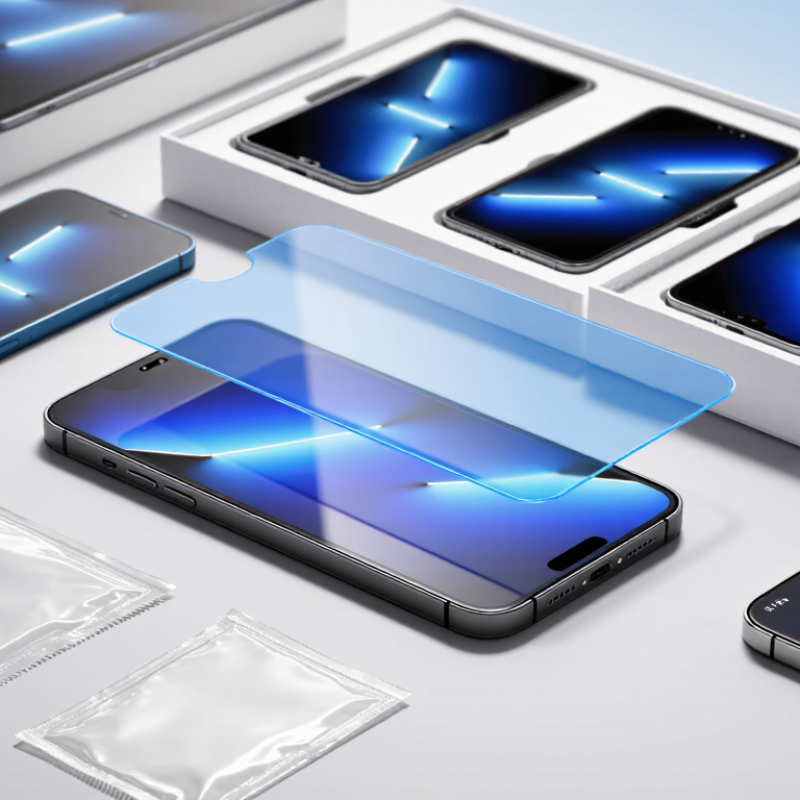
Blue light is commonly discussed as the 400–500 nm band within the visible spectrum. The CIE’s visible-spectrum boundaries are broader, and exact limits can vary by convention. A screen protector may reduce some wavelengths in this band, but “blue-light filtering” does not describe one standard performance level. Not all alike. The amount filtered depends on the product’s spectral transmission, not just its tint. A yellow cast may be noticeable, while a clear film can still filter selected wavelengths.
For wholesale buyers, request a transmission curve covering the full 400–500 nm range. A single reduction percentage may hide uneven performance across the band. Check how the film affects visible clarity, color balance, touch response, and adhesion. Ask for test conditions and supporting reports, ideally from a qualified independent laboratory. These details make comparisons more useful than packaging claims alone. I would also inspect samples on different displays; results can look less convincing under warm indoor lighting.
Tips: Compare like-for-like test data, and ask which wavelengths the stated percentage covers. Check samples in bright and dim settings. Keep expectations measured: filtering selected blue wavelengths does not prove that a protector prevents eye strain or improves sleep.
For wholesale buyers, “blue-light blocking” is not a complete performance measure. Ask for a spectral transmission curve covering 400–500 nm, not just one headline percentage. The curve shows how much light passes through at each wavelength. Lower transmission means stronger filtering at that point, but a sharp cutoff is not automatically better. Some protectors reduce transmission mainly near 400 nm; others filter more broadly and may noticeably warm the display.
Request test data from a spectrophotometer, with the test range, measurement interval, and sample condition stated. Compare protectors against the same uncoated glass reference. Check readings around 420, 450, and 480 nm, as well as the full curve. A single average can conceal uneven performance. That detail matters.
Check several samples from different production batches. Small variations in coating thickness can shift the curve or create visible color differences. Ask suppliers for both transmission results and a display photo showing white and gray screens. Measurement conditions matter, and figures from separate laboratories may not align perfectly. A tidy chart can still leave questions.
Filtering also affects brightness and color appearance. Buyers should balance measured reduction with clear text, neutral whites, and touch response on finished devices. One test is not enough. I would treat supplier data as a starting point, then verify representative samples before placing a large order.
Cochrane’s review examined 17 randomized trials of blue-light-filtering spectacle lenses, not screen protectors. Across the studies, these lenses showed little or no short-term benefit for reducing eye strain compared with ordinary lenses. The trials were generally small and brief, so the findings do not settle every question.
Important caveat.
For wholesale buyers, that distinction matters. Evidence about eyewear cannot automatically prove that a film applied to a phone or monitor will produce the same results. Claims about preventing eye damage or reliably improving sleep also need careful scrutiny; the review found sleep-related evidence uncertain and did not establish long-term protection. A tinted sample on a display may look convincing, but appearance is not proof of a health benefit.
A practical assessment can still focus on measurable product qualities: fit, clarity, glare, touch response, and how colors look on a white screen. Check these under ordinary indoor lighting, not just bright showroom lamps. Ask suppliers for test methods and avoid turning limited research into a medical promise. I would be cautious here; the evidence is not tidy, and buyers should say so plainly.
Wholesale buyers should request measured clarity data, not rely on “HD” or “anti-glare” labels. ASTM D1003-21 measures haze and luminous transmittance for transparent plastics, reporting both as percentages. Ask suppliers for test results from finished protectors, since adhesive layers can change the readings. Compare samples on the same display: small text should stay crisp, and white backgrounds should not look milky. Look closely. One measurement can still mislead.
Touch response needs a practical check. Test repeated taps and swipes across the center, corners, and screen edges, with the protector installed and the display clean. Record missed inputs and any extra pressure needed. For durability, use a repeatable abrasion procedure and inspect for scratches, lifting edges, bubbles, and coating wear after cleaning cycles. A harder surface is not automatically a better product; excessive brittleness can create other problems. Ask for the test method, sample count, and conditioning details alongside each result. Without those details, comparisons are weak. I would also keep one sample for a second inspection, because early checks can miss gradual haze or edge lift.
Top Anti Blue Light Screen Protectors for Wholesale Buyers
Wholesale sourcing works best when MOQ, unit cost, compliance, and defect rates are reviewed together. A low MOQ can reduce inventory risk, but it may raise the unit price. Compare quotes at several quantities, such as 500, 1,000, and 5,000 pieces. Ask whether packaging, freight, and inspection costs are included. Small details matter. A filter percentage alone does not show whether a protector fits cleanly or affects screen clarity. Request samples and check them on the device models your customers actually use.
Tips: Get the MOQ and price breaks in writing. Request current compliance documents relevant to your sales markets, and confirm they match the exact material and product version. Test sample adhesion, touch response, and visible defects under bright light.
Before placing a large order, agree on a defect definition and inspection method. For example, specify how to count bubbles, scratches, edge lifting, and incorrect cuts. Ask the supplier for recent defect data, but treat it as a starting point, not proof. A small pilot order can reveal issues that polished samples miss. It adds time. Still, skipping it may cost more through returns, replacement stock, and unhappy resellers. Keep records of batch numbers and inspection results so recurring problems are easier to trace.