What Are the Best Outdoor Trampolines in 2026?
Choosing the best Outdoor Trampoline in 2026 is about more than finding the biggest jumping surface or the lowest price. A good choice should fit your yard, your family, and the way you plan to use it. Measure the space carefully, including room around the frame, and consider whether the ground is level and exposed to strong winds. That sounds simple. It isn’t. A few feet can change how safely a trampoline fits.
This guide compares Outdoor Trampoline options by practical details: frame construction, jumping mat, enclosure design, weight limits, assembly needs, and care requirements. These features matter when the trampoline faces rain, sun, and regular family use. Check the manufacturer’s instructions before buying, especially for age guidance, anchoring, and safe-use recommendations. Look closely at replacement-part availability, too; a worn net or mat can affect how long the product remains useful. No model is perfect. Some sturdy designs take longer to assemble, while compact options may feel limiting as children grow. Product specifications are useful, but they cannot guarantee how a trampoline will perform in every yard or climate. The right pick depends on your space, budget, and willingness to maintain it. We’ll highlight the trade-offs so you can compare options without treating a single feature as the whole story.
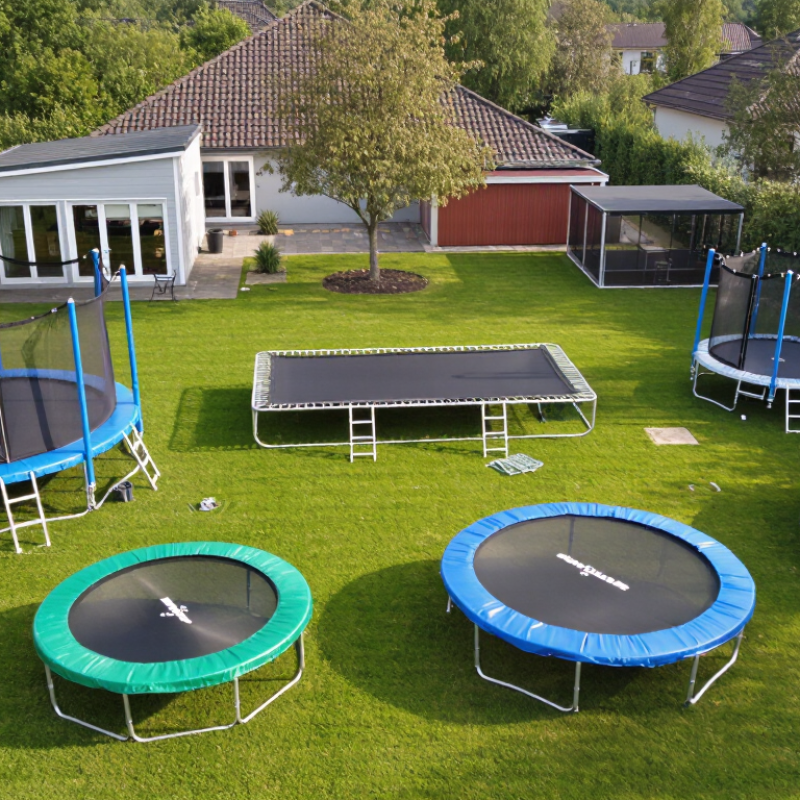
Outdoor Trampoline Basics: Frame, Jumping Mat, Springs, and Enclosure
An outdoor trampoline’s frame does more than hold the jumping surface. Look for sturdy, evenly joined sections, capped edges, and legs that sit firmly on level ground. A frame that rocks on grass can shift during use, even when it looks substantial. Check joints for rust or loose fittings after wet weather. Small details matter.
The jumping mat should feel taut, with intact stitching and no brittle, faded patches. UV exposure can weaken materials over time, though wear is not always obvious at a glance. Springs should be evenly attached and covered by a pad that stays in place. More springs do not automatically mean a better bounce; mat size, spring condition, and weight limits also matter. Read the product’s care instructions, since construction varies.
An enclosure helps keep jumpers from stepping off the edge, but it is not a substitute for supervision. Check that netting closes fully and has no gaps near the mat. Posts should be padded, and the net should not sag into the jumping area. I would inspect the whole setup before each session, especially after wind. That takes a minute. It is easy to skip when everyone is eager to jump.
Compare Jumping-Area Size, Weight Limits, and Bounce Design
What Are the Best Outdoor Trampolines in 2026?
Compare Jumping-Area Size, Weight Limits, and Bounce Design
Start with the usable jumping area, not the frame’s outside diameter. A broad frame can hide a smaller mat, leaving less room for comfortable movement. Check the mat dimensions and the total footprint, then measure the yard with space around the trampoline. CPSC estimated 104,691 trampoline-related emergency-department visits in 2014; that dated figure is a useful reminder that size and safe setup matter. ASTM F381-16 sets safety requirements for consumer trampoline components, assembly, and use. Look for clear assembly instructions and inspect the enclosure, frame, and mat before buying.
Weight limits need careful reading. A listed capacity is a ceiling, not a promise that several jumpers can use the trampoline safely together. Compare the limit with the intended user’s weight, and follow the manual’s rules on occupancy. Bounce depends on more than spring count: mat tension, spring length, and the frame’s overall design all play a part. A very firm bounce may feel exciting, but it is not automatically better. Honestly, product specs cannot fully describe how a trampoline feels underfoot.
Tips: Measure the mat, not just the frame. Check weight limits and occupancy rules in the manual. Inspect stitching and springs regularly. A little tedious, but worthwhile.
Safety Benchmarks: ASTM F381-16(2023) and CPSC Injury Data
A backyard trampoline can look sturdy on a sunny afternoon. Safety depends on details that are easy to miss. ASTM F381-16 (2023) sets safety requirements for consumer trampolines, including design and warning provisions. When comparing models, check whether the exact product—not just a product line—is represented as meeting this standard. Look closely at the enclosure, frame padding, springs, and entry point. A small gap near the net can matter when a child lands awkwardly.
CPSC injury reports offer another useful lens. They document trampoline injuries such as fractures, sprains, and head injuries, often involving falls or contact between jumpers. These reports do not predict the risk for one household, but they show why equipment features alone cannot control every hazard. One jumper at a time. Keep the mat clear, supervise actively, and inspect seams and net fasteners for wear. ASTM compliance is a benchmark, not a promise of injury-free play. I would still check the manual and assembly carefully; even a well-made enclosure is less reassuring when a pole is loose or the net sags. Safety is partly a buying decision, and partly a routine repeated before each session.
Outdoor Trampoline Safety: ASTM Benchmarks and CPSC Injury Data
A historical snapshot of trampoline-related emergency-department injuries in the United States.
How to read this: The U.S. Consumer Product Safety Commission estimated 98,000 trampoline-related injuries treated in emergency departments in 2009. This historical estimate is not a current annual count or an individual trampoline’s risk rating. ASTM F381-16(2023) sets safety requirements for consumer trampolines; check the standard and product documentation when comparing safety features. Neither this data point nor ASTM compliance ranks products or guarantees injury prevention.
Source: U.S. Consumer Product Safety Commission (CPSC), estimated emergency-department-treated trampoline injuries, 2009. Benchmark reference: ASTM F381-16(2023).
Weather Readiness: Galvanized Steel, UV Resistance, and Wind Anchoring
Outdoor trampoline weather readiness begins with the frame, not the bright colors or extra accessories. Galvanized steel helps resist rust, especially where rain collects around joints and bolt holes. Still, “galvanized” does not mean maintenance-free. Check for chipped coatings, loose hardware, and standing water after wet weather. Small details matter.
UV-resistant jumping mats and enclosure nets can slow sun damage, but they may still fade or weaken over time. Look for clear care instructions and inspect stitching, seams, and attachment points each season. A brittle edge or frayed strap is a reason to stop use until it is replaced. I would not judge fabric strength by appearance alone; a clean, vivid surface can hide wear.
Wind needs its own plan. Use suitable ground anchors, fitted securely according to the manufacturer’s instructions, and check them after the soil becomes soft or dry. Wind is different. In strong gusts, anchors may not be enough, so follow the product’s weather guidance and secure or dismantle exposed parts when advised. It is easy to assume a heavy frame will stay put. That assumption deserves a second look.
2026 Best Picks by Yard Size, Budget, and Verified Safety Features
What Are the Best Outdoor Trampolines in 2026?
For a small yard, choose a compact round trampoline and leave clear space around it; measure the full frame, not just the jumping mat. Small yards need restraint. Larger yards can fit rectangular models, but their extra bounce space is not a safety feature by itself. CPSC’s 2014 NEISS-based injury estimate counted 104,691 trampoline-related emergency-department visits in the United States. That older figure is not a 2026 forecast, but it shows why safety details deserve more attention than flashy extras.
On a tighter budget, keep an enclosure, spring or frame padding, and a sturdy frame ahead of add-ons. Check whether the maker documents testing to ASTM F381, the consumer trampoline safety specification, and read the manual for setup and use limits. A standard is useful evidence, not a promise of zero risk. Yard shape can also be awkward; a trampoline that technically fits may leave little room to walk safely around it.
Tips: Measure the site and overhead clearance before buying, then compare them with the manual’s requirements. Inspect net seams, padding, and frame connections after assembly. CPSC injury data cannot tell you which model is safest, so verify the exact product’s safety documentation. A little inconvenient, perhaps—but skipping that check is a poor bargain.