How to Choose the Best Water Drink Machine from China?

Choosing the best water drink machine from China requires more than comparing prices online. The right choice begins with water quality, daily demand, installation conditions, and after-sales support. A machine for a hotel lobby may need different filtration and cooling capacity than one serving a factory workforce.

Dr. Peter Gleick, a respected water expert, has said, “Water is a human right.” That principle should guide every purchasing decision. A reliable water drink machine must protect users through suitable filtration, safe materials, stable temperature control, and clear maintenance procedures. Look for food-grade stainless steel, dependable reverse osmosis membranes, ultraviolet sterilization, and accurate monitoring instruments. Do not accept impressive specifications without test evidence.

Ask the Chinese supplier for water-flow data, filter replacement intervals, electrical requirements, and real installation photographs. Examine the internal layout. Are pipes easy to reach? Can technicians replace filters without dismantling half the machine? Small details matter.

A low price can look attractive. It can also hide future costs. Cheap pumps, weak compressors, or unavailable spare parts may create expensive downtime. Request a sample test when possible, and verify production quality through factory videos, inspection records, or an independent audit.

Still, no machine is perfect. Local water conditions may expose weaknesses that brochures never mention. Consider hardness, sediment, microbial risks, climate, and user habits before ordering. A trustworthy manufacturer should discuss these limitations honestly. The best water drink machine is not simply the cheapest model from China. It is the system that delivers safe, consistent water and remains serviceable long after installation.
How to Choose the Best Water Drink Machine from China?

Understanding Water Drink Machines and Their Main Types

Understanding Water Drink Machines and Their Main Types

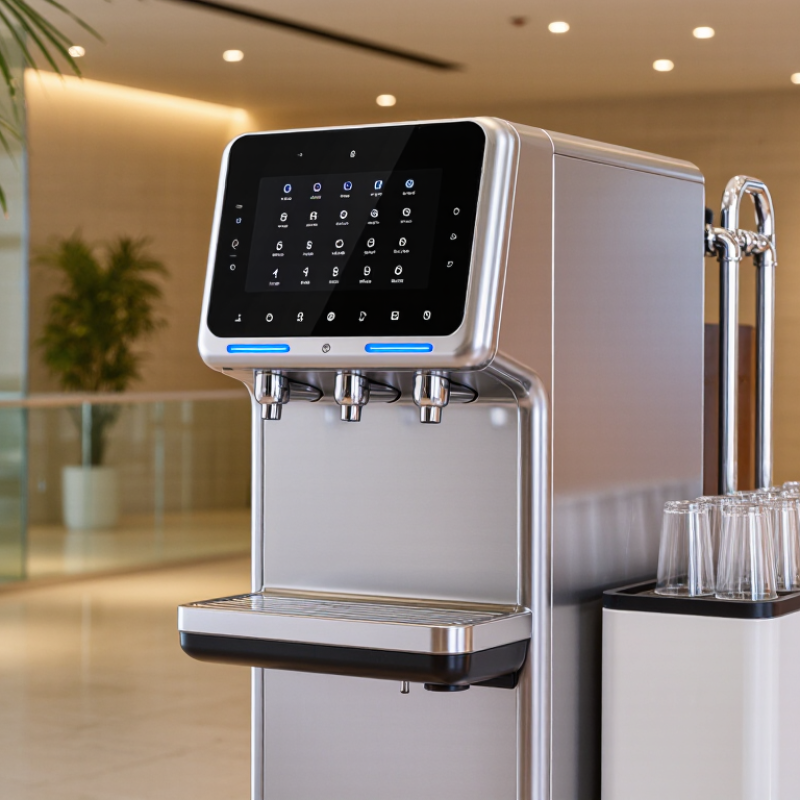
A water drink machine usually means a dispenser that cools, heats, filters, or combines these functions. The main types are point-of-use, bottled, countertop, and under-sink systems. Point-of-use models connect directly to a water line and often use sediment, carbon, or membrane filters. Bottled machines work well where plumbing is limited. Countertop units save space, while under-sink systems keep the treatment equipment hidden. Choose by water source, daily volume, installation space, and maintenance access.

The WHO and UNICEF Joint Monitoring Programme reported that 2.2 billion people lacked safely managed drinking water in 2022. That figure makes filtration performance more than a convenience. Ask Chinese suppliers for test reports, filter-life data, flow rates, and safety documentation linked to recognized standards. A practical inspection should include tubing, seals, drain trays, and hot-water protection. Small parts matter.

Grand View Research valued the global water dispenser market at about USD 4.9 billion in 2023 and expects continued growth through 2030. However, market growth does not guarantee quality. Energy use deserves attention, especially for machines that heat water continuously. I would compare standby power, heating speed, noise, and replacement-filter cost. I once underestimated service access; a compact machine can become difficult to repair. That mistake is worth avoiding.

How to Choose the Best Water Drink Machine from China?

Understanding the main machine types helps match the equipment to your water source, installation space, and daily usage.

Reading the chart: 1 means the feature is commonly inherent to that machine type, while 0 means it is not normally inherent. Actual configurations vary by model, especially for countertop and point-of-use machines.

Defining Your Water Production and Dispensing Requirements

How to Choose the Best Water Drink Machine from China?

Define the water job before comparing machine prices. The WHO/UNICEF Joint Monitoring Programme reported that 2.2 billion people lacked safely managed drinking water in 2022. Water quality cannot be assumed. Test the source for turbidity, hardness, total dissolved solids, iron, and microbial contamination. A clear sample may still require serious treatment.

Measure demand by people and peak periods, not daily averages. A small office may need 50–100 liters daily, while a school or factory can require several times more. Record the busiest hour, number of dispensing points, and preferred water temperature. Then calculate production capacity with a safety margin. For example, a 100-liter peak requirement may justify 120–150 liters per hour. It is not perfectly efficient, but under-sizing creates queues and overheated components.

Consider incoming water pressure, electricity stability, drainage, ambient temperature, and replacement-filter access. China-made equipment can be configured with sediment filters, carbon treatment, membrane filtration, ultraviolet disinfection, or hot-water modules. Each option adds maintenance. WHO drinking-water guidance emphasizes risk management from source to consumer, so ask for test reports, material specifications, sanitation procedures, and factory quality records. Check applicable electrical and drinking-water compliance requirements in the destination market. A practical mistake is choosing impressive flow rates without checking recovery rates and storage volume. Ask for real operating data, not only catalog figures.

Evaluating Suppliers, Materials, Technology, and Safety Standards

How to Choose the Best Water Drink Machine from China?

Supplier evaluation should begin with evidence, not attractive photographs. The WHO and UNICEF Joint Monitoring Programme reported that 2.2 billion people lacked safely managed drinking water in 2022. That figure makes treatment reliability more important than appearance. Request factory audit records, production capacity, batch traceability, and recent laboratory reports. I would not trust a certificate screenshot alone. Verify the issuing laboratory and test scope.

Material selection affects taste, durability, and hygiene. For wetted parts, ask for food-contact documentation under China’s GB 4806.7 standard. Stainless steel grades should be clearly identified, rather than described as “premium metal.” Check welds, seals, tubing, and storage tanks. Small details matter. The WHO Guidelines for Drinking-water Quality recommend controlling microbial and chemical risks through validated treatment and maintenance. A machine using reverse osmosis may need remineralization, while ultraviolet treatment requires clean water and adequate lamp performance. Technology is not automatically protection.

Safety testing must cover electrical insulation, overheating, leakage, pressure, and child-accessible hot water. Compare reports with applicable GB requirements and relevant IEC safety methods. Ask whether tests represent the final assembled machine, not only individual components. My first supplier comparison focused too heavily on filtration claims. That was a mistake. After-sales support, replacement filters, calibration procedures, and response time deserve equal attention. A lower quotation can become expensive when records are incomplete or parts arrive late.

Comparing Costs, Customization Options, Certifications, and Support

Choosing a water drink machine from China requires more than comparing the factory price. Grand View Research projects the global water purifier market to grow at about 7% annually through 2030. Demand is rising, but specifications vary sharply. Compare the total landed cost: machine, filters, tooling, shipping, installation, spare parts, and testing. A low quote may hide expensive replacement cartridges or custom molds. I learned this the hard way after an attractive quotation excluded electrical adaptation and local delivery.

Customization should follow real usage. Ask for water temperature ranges, hourly output, filtration stages, power requirements, drainage design, and countertop dimensions. Request a sample unit before approving mass production. Stainless-steel contact parts, clear service panels, and removable filter housings make daily maintenance easier. However, excessive customization can increase tooling costs and delay production. Sometimes a standard cabinet is the wiser choice.

Certifications need careful verification. NSF/ANSI 42 addresses aesthetic effects, while NSF/ANSI 53 covers specific health-related contaminants; NSF/ANSI 58 applies to reverse-osmosis systems. IEC 60335-2-15 is relevant to household appliances that heat liquids. CE marking may support European market access, but it is not independent proof of filtration performance. Ask for current certificates, laboratory reports, test scopes, and model numbers. Support matters just as much. Clarify response times, remote troubleshooting, replacement-part stock, warranty exclusions, and technician training. The 2023 WHO/UNICEF Joint Monitoring Programme report shows that billions still lack safely managed drinking water, so reliability is not a cosmetic feature. Test it under real conditions. Then question your assumptions.

Inspecting Samples and Choosing the Right Chinese Manufacturer

Choosing a water drink machine from China should begin with the sample, not the catalog. The WHO/UNICEF Joint Monitoring Programme reported that 2.2 billion people lacked safely managed drinking water in 2022. That figure makes filtration, heating, cooling, and hygiene controls important. I request three samples from different production batches. One sample is never enough. I measure dispensing volume, temperature recovery, noise, leakage, and standby power. A simple test helps. Place white tissue beneath every joint overnight. It can reveal slow leaks better than polished photographs.

During a factory visit, I match sample serial numbers with incoming-material records and assembly instructions. The ISO Survey 2023 listed more than 1.2 million ISO 9001 certificates worldwide, but certification alone cannot prove stable output. Ask for recent electrical, material-contact, and performance test reports. Check whether the reports match the exact model and components. Inspect stainless-steel surfaces, silicone seals, filter housings, and cable connections by hand. I once trusted a clean sample too quickly. Later, the replacement parts showed uneven molding. That mistake changed my audit checklist. Confirm production capacity, inspection frequency, spare-part availability, and response time in writing. A capable Chinese manufacturer should explain failures clearly, not hide behind attractive packaging.

How to Choose the Best Water Drink Machine from China? - Inspecting Samples and Choosing the Right Chinese Manufacturer

Evaluation Dimension Recommended Benchmark or Acceptance Range How to Inspect the Sample Evidence to Request from the Manufacturer Suggested Weight Decision Guidance
Water treatment configuration Configuration should match the inlet-water analysis. Typical options include sediment filtration, activated carbon, ultrafiltration, reverse osmosis, UV treatment, or a combination. Compare the proposed treatment stages with the measured turbidity, hardness, total dissolved solids, chlorine, iron, and microbiological condition of the target water source. Water-flow diagram, component list, recommended replacement interval, and a written explanation of the treatment purpose of each stage. 15% Reject systems that use a generic filter package without validating it against the actual water conditions.
Material safety and wetted parts All water-contacting parts should be identified, traceable, corrosion-resistant, and suitable for drinking-water contact in the destination market. Inspect tubing, tanks, valves, fittings, seals, faucets, and internal surfaces for material markings, odor, discoloration, burrs, and difficult-to-clean areas. Material declarations, food-contact or drinking-water-contact test reports, component specifications, and traceability records. 15% Do not accept unexplained material substitutions between the approved sample and mass production.
Filtration performance Performance must be stated for the exact filter model, flow rate, water temperature, pressure, and contaminant tested. Nominal and absolute ratings must not be confused. Record inlet and outlet readings under the specified operating conditions. Check whether the supplied filter matches the approved specification. Independent test reports, filter datasheets, test conditions, production batch records, and replacement-filter identification. 12% Treat unsupported contaminant-removal claims as unverified, even when the machine has several filter stages.
Flow rate and dispensing capacity The measured flow rate should meet the agreed specification at the stated inlet pressure and temperature. A practical acceptance limit is usually within ±10% of the approved sample result. Dispense at least three consecutive volumes after stabilization. Record output volume, filling time, inlet pressure, and water temperature. Rated flow curve, pump specification, pressure requirements, and factory test records. 10% Use the real installation conditions when comparing suppliers; advertised maximum flow is not a universal operating result.
Leakage and pressure resistance The complete water circuit should remain leak-free during the agreed pressure-hold test and after repeated dispensing cycles. Pressurize the machine according to the approved test procedure, hold the pressure for the specified time, and inspect all joints, housings, tanks, and drain lines. Pressure-test procedure, test records, sealing-component specifications, and corrective-action reports for previous failures. 12% Any visible leakage, moisture accumulation, or unstable pressure should be treated as a critical failure.
Electrical safety and protection Voltage, frequency, plug type, grounding, insulation, over-temperature protection, and ingress protection must match the destination-market requirements. Check labels, wiring, grounding continuity, cable strain relief, fuse protection, abnormal-operation response, and enclosure condition. Electrical schematic, safety test reports, declaration of conformity where applicable, and destination-market compliance documents. 10% A general certificate is insufficient if it does not cover the exact model, configuration, and market version.
Cooling or heating performance Temperature range, recovery time, storage volume, and continuous-output capacity should be agreed before sampling and verified under rated ambient conditions. Measure outlet temperature and recovery time over repeated dispensing cycles. Check thermal cut-off operation and condensation management. Compressor or heater data, energy-consumption data, thermal-protection design, and performance test records. 8% Compare machines using the same ambient temperature, inlet-water temperature, load, and test duration.
Sanitation and cleanability The design should minimize stagnant water, dead legs, inaccessible cavities, and biofilm-prone surfaces. Cleaning and sanitizing instructions must be documented. Disassemble serviceable parts, inspect internal surfaces, check drainability, and run the stated cleaning and sanitizing procedure. Cleaning manual, sanitation chemicals and concentrations, maintenance schedule, hygienic-design drawings, and microbiological test method. 10% Prefer designs that can be fully drained and serviced without damaging seals or contaminating the water path.
Noise, energy use, and operating cost Noise and energy limits should be defined for a specific operating mode. Calculate total cost using electricity, filters, membranes, sanitation, spare parts, and labor. Measure noise at a fixed distance and record power consumption over a representative operating cycle. Confirm filter-life assumptions. Energy test conditions, acoustic test method, filter replacement schedule, spare-parts price list, and warranty terms. 5% A lower purchase price may be uneconomical if consumables and service costs are high.
Manufacturer capability and quality control The manufacturer should demonstrate controlled purchasing, incoming inspection, assembly records, final testing, calibration management, and traceability for critical parts. Audit the production line, warehouse, testing area, quality records, calibration labels, nonconforming-product controls, and sample-to-production consistency. Quality-management certificate, factory-audit report, process-control plan, inspection checklist, defect-rate data, and corrective-action records. 13% Choose the supplier with the strongest verifiable process control, not only the lowest quotation.
After-sales support and spare parts Critical spare parts, service manuals, troubleshooting guidance, and a defined response process should be available for the expected service period. Request a spare-parts kit, test the technical-support response, and verify whether common components can be replaced with standard tools. Warranty policy, service-level agreement, parts availability statement, exploded drawings, repair videos, and technician training materials. 10% Do not approve a supplier that cannot identify the replacement parts required for routine maintenance.
Total Evaluation Weight 100% Approve only after sample testing, document review, and production-quality verification.
Inspection Note: Benchmark values should be finalized against the destination country’s drinking-water, electrical-safety, labeling, environmental, and import requirements. Test results are meaningful only when the model configuration and test conditions are recorded.